
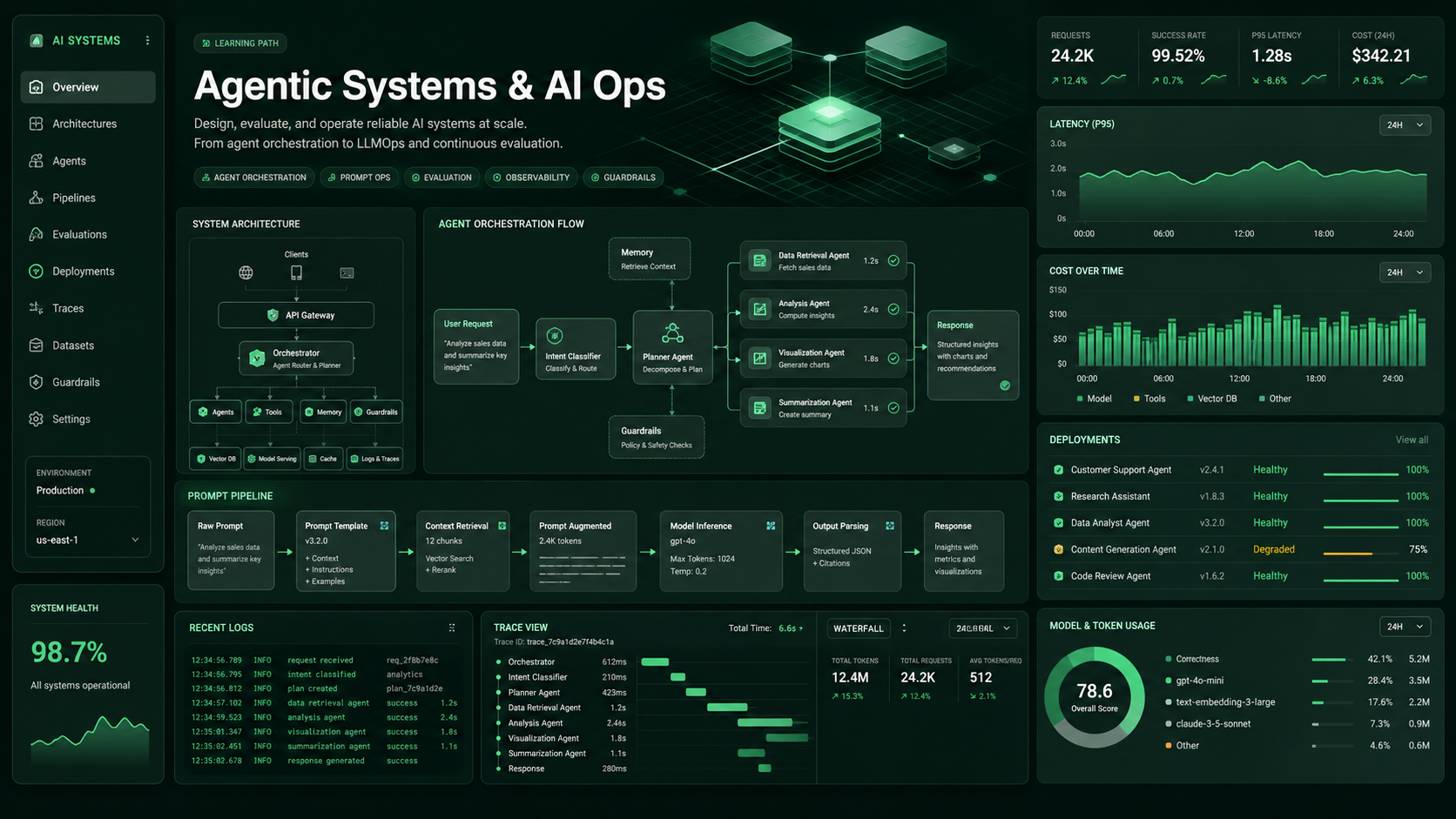
Design and Operate Production-Ready AI Systems
10
learning tracks
System design, agents, RAG, prompts, and ops
8
hands-on labs
Architect, build, evaluate, and deploy scenarios
1
production workflow
Design → Improve with monitoring and iteration
A structured learning path for developers who want to build production AI systems.
Production AI learning path
Learn the operating model behind real AI products.
This path connects prompt design, retrieval, agents, deployment, observability, and evaluation into one practical system design workflow.
Production readiness
Learn to design for latency, failure modes, rollback, and safe launch conditions from the start.
Reliability and control
Use guardrails, tests, and fallback flows so AI systems stay usable when outputs drift.
Operational visibility
Instrument traces, metrics, logs, and cost signals before a system reaches production traffic.
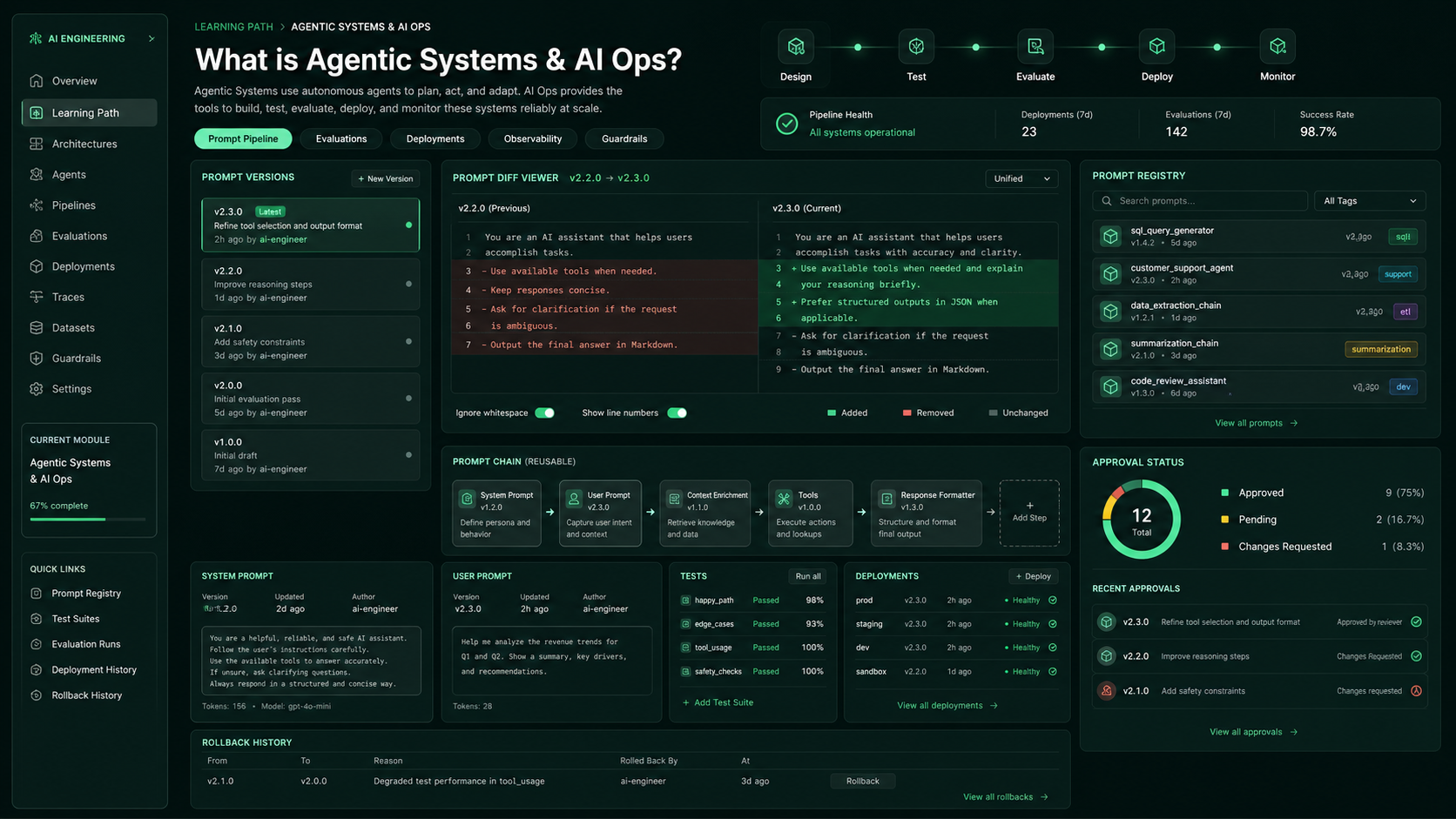
prompt_v2.3 -> retrieval -> tool call -> eval gate
changes tracked: version, tests, rollout, rollback
production rule: ship only when the scorecard passes
Ten tracks that cover the full production AI stack.
AI System Design
Define service boundaries, latency budgets, failure modes, data flow, and operating constraints before launch.
LLM Application Architecture
Compose prompts, retrieval, context packing, structured outputs, and API integrations into one resilient app.
Agent Architecture
Plan tool use, memory, routing, role separation, and safety checks so agents act predictably.
RAG Infrastructure
Design chunking, indexing, retrieval, reranking, and answer grounding for production usage.
Vector Databases
Choose embeddings, schema, filters, and search tuning that keep semantic retrieval fast and relevant.
Prompt Pipelines
Version prompts, track diffs, and coordinate templates, tests, and rollout rules across products.
LLMOps & MLOps
Connect datasets, models, deployments, experiments, and release hygiene into one operating pipeline.
Observability & Monitoring
Track traces, logs, metrics, alerts, and red flags before incidents become outages or costly regressions.
Evaluation & Guardrails
Write test cases, automate scoring rubrics, detect drift, and place policy checks around model behavior.
Deployment & Scaling
Ship with CI/CD, autoscaling, caching, fallback flows, and cost controls that hold up under load.
Build the architectures people actually run.
Design a production chatbot architecture
Sketch the full stack, from user input and prompt routing to retrieval, responses, logs, and fallback handling.
Build a RAG pipeline with vector search
Chunk documents, build embeddings, index knowledge, and tune retrieval quality for grounded answers.
Create an agent workflow with tools and APIs
Route tasks through planner, tools, memory, and execution steps while keeping behavior safe and observable.
Add logging, tracing, and monitoring to an AI app
Instrument the system so latency, failures, prompt quality, and tool calls are visible in production.
Evaluate LLM responses with test cases
Build test suites that check grounding, correctness, policy adherence, and regression risk.
Design fallback flows for unreliable AI outputs
Add retries, safe responses, human review paths, and degraded modes for high-risk output failures.
Optimize AI system latency and cost
Trim prompt size, cache outputs, tune models, and rebalance retrieval to hit latency and budget targets.
Deploy an AI service with CI/CD
Ship with tests, environment controls, versioned releases, and a repeatable deployment workflow.
A step-by-step path from idea to continuous improvement.
Hover any outer step to explore the path
Design
Map service boundaries, dependencies, risk areas, and operating goals before any code ships.
Build
Implement prompt layers, tool integrations, retrieval, and application logic in a clean stack.
Connect Data
Wire documents, embeddings, vector indexes, and live data sources into the system.
Orchestrate Agents
Route tasks through planner, tools, memory, and approval steps with predictable behavior.
Evaluate
Run regression tests, scoring rubrics, and scenario checks before every rollout.
Deploy
Release through CI/CD, guarded versions, and environment-aware rollout controls.
Monitor
Watch latency, traces, token usage, errors, and cost in live production traffic.
Improve
Use findings to refine prompts, architecture, fallback flows, and operational policies.
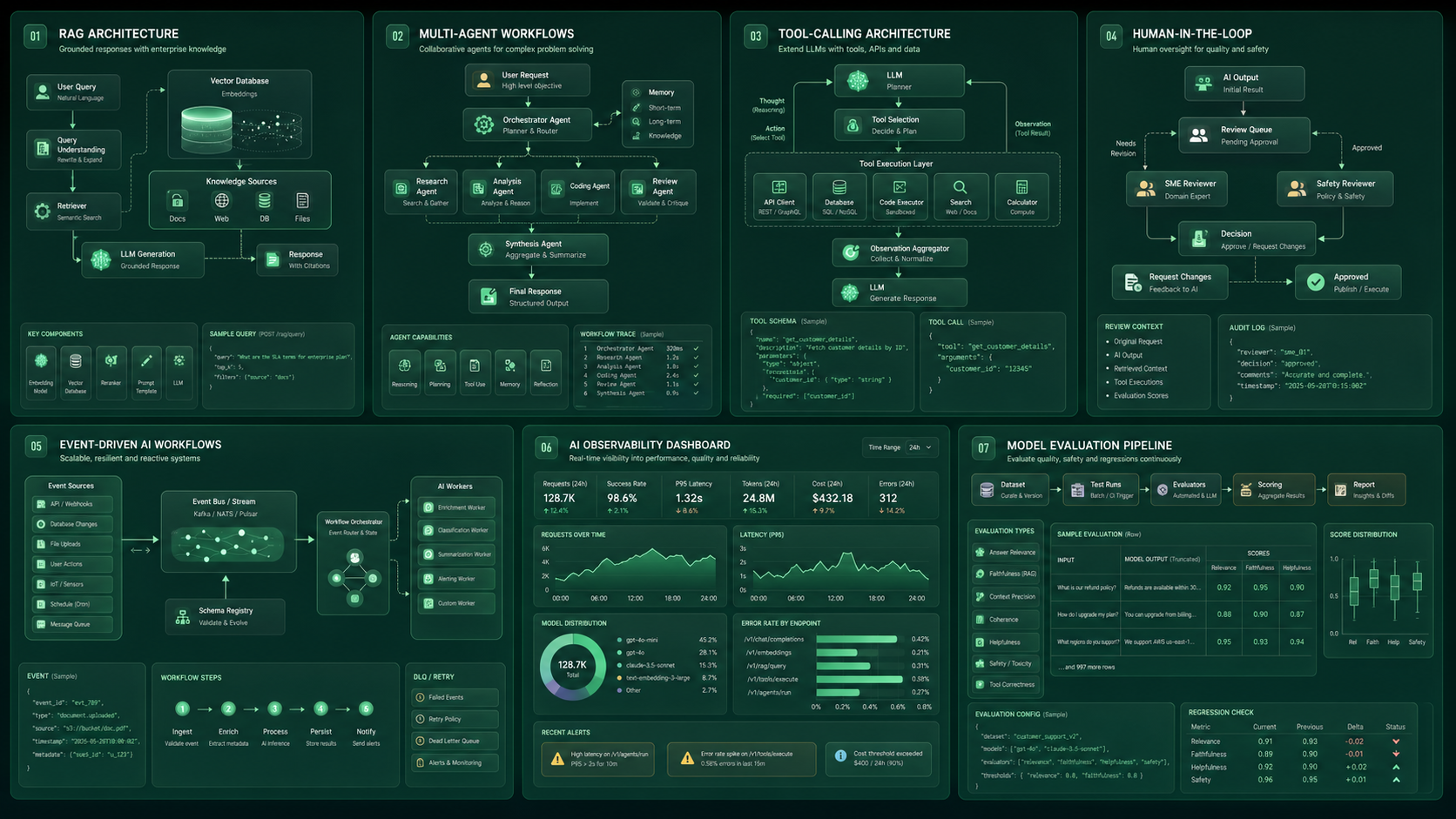
Learn the patterns that appear again and again in production AI systems.
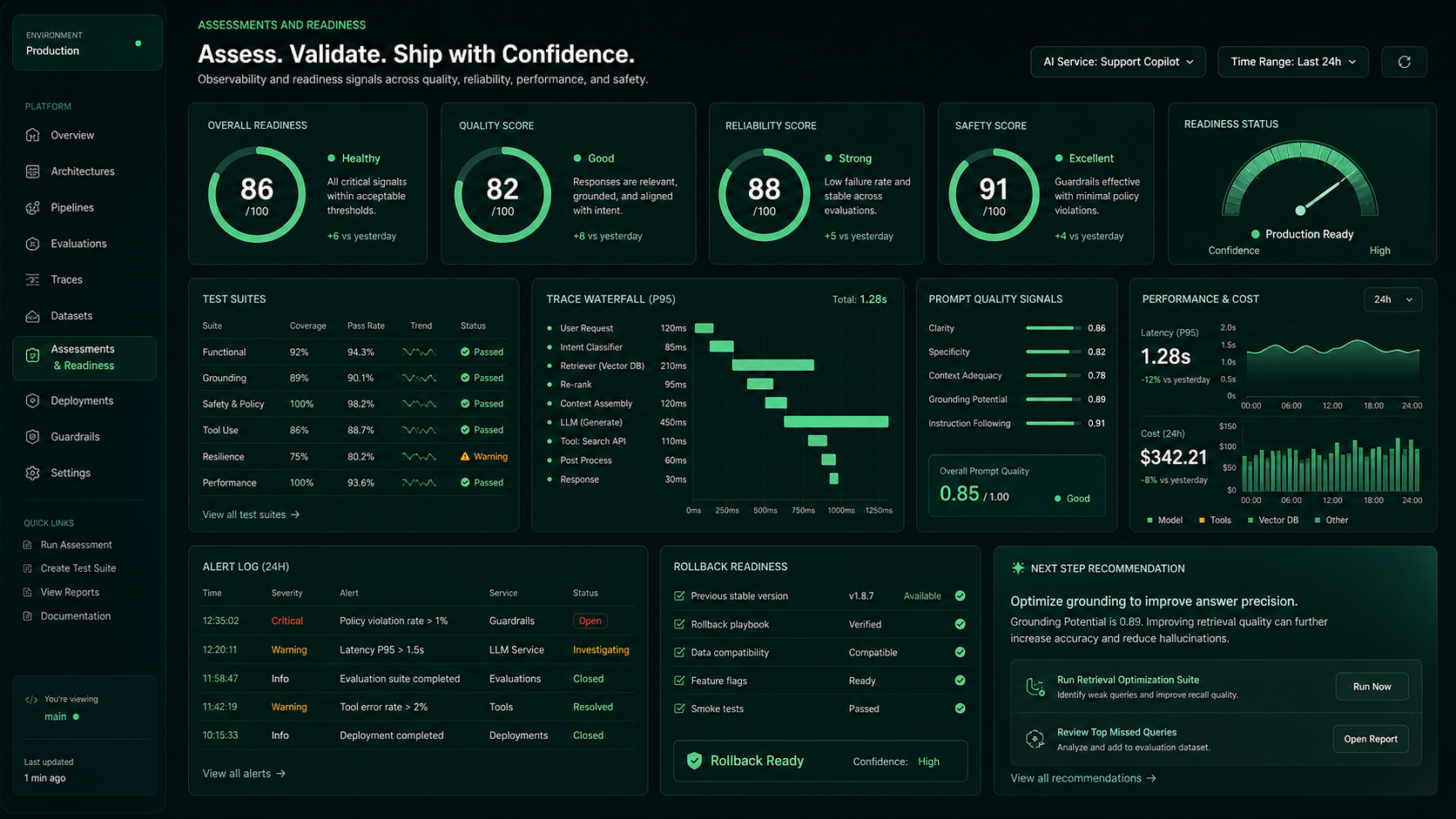
Prove readiness with quizzes, challenges, and system design evidence.
7
assessment modes
Quizzes, challenges, debugging, and case studies
AI
generated reports
Summaries of strengths, gaps, and next actions
Live
readiness scoring
Scores update after every lab or submission
Assessment stack
- Quizzes that check core concepts and decision logic
- Architecture challenges that test tradeoffs and system boundaries
- Debugging tasks that surface reliability and failure handling
- System design case studies that connect components end to end
- Project submissions that prove implementation quality
- AI-generated reports that summarize strengths and gaps
- Readiness scoring that updates after every attempt
One path that helps learners and engineering orgs alike.
Developers
Build the habits behind production-ready AI products, not just demos or prompt experiments.
Outcome
Ready to ship and support AI systems
Students
Use the path to prepare for AI engineering roles with portfolio-ready work and clear review loops.
Outcome
Interview-ready architecture stories
Companies
Train teams on LLMOps, reliability, observability, and a shared production AI operating model.
Outcome
Standardized AI delivery playbooks
Engineering teams
Align design reviews, rollouts, monitoring, and guardrails across squads and product lines.
Outcome
Safer launches and easier maintenance
Move from AI prototypes to reliable production systems.
Build the habits, architecture patterns, and operational discipline that turn AI experiments into systems teams can trust.