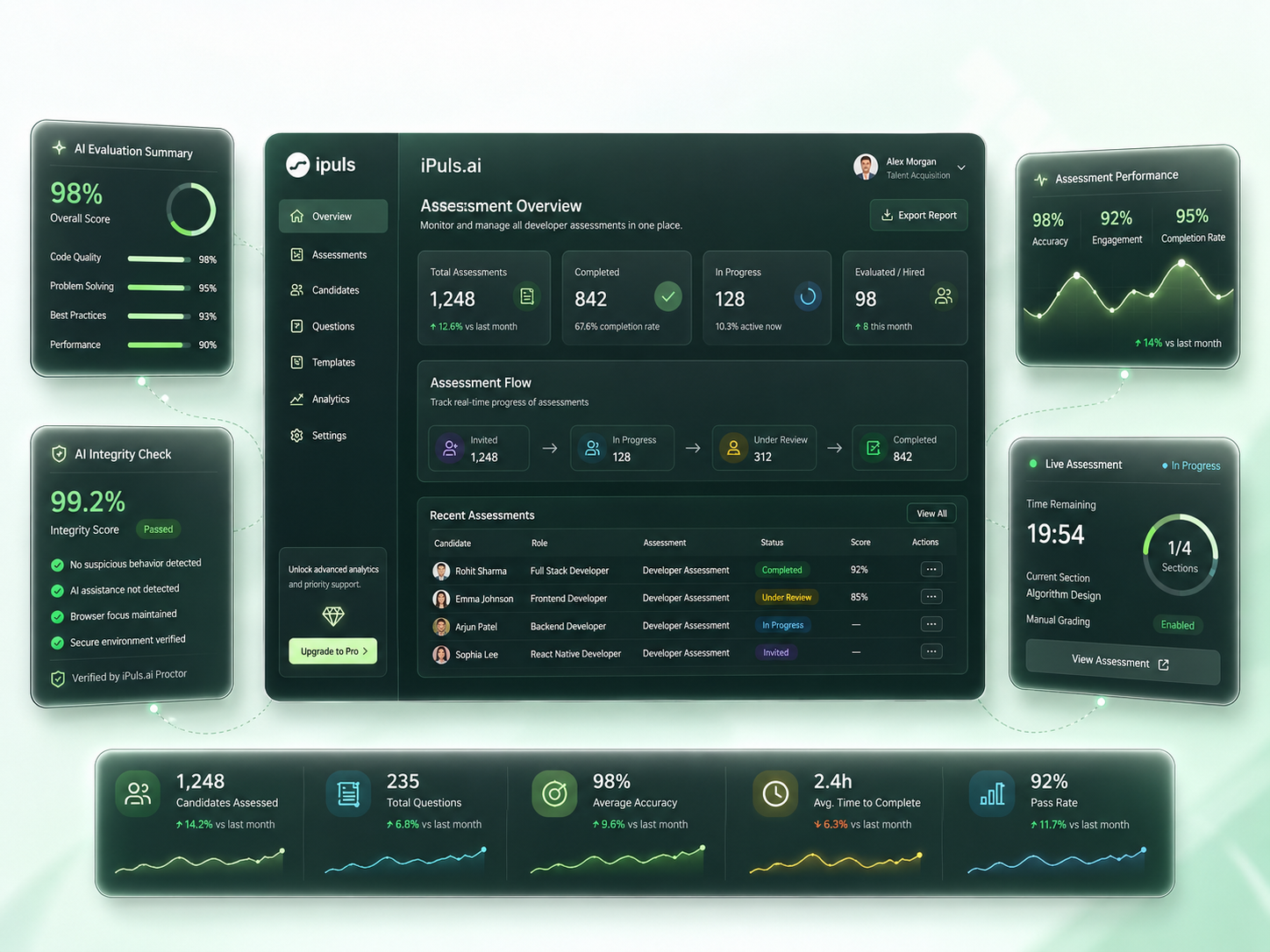

AI-driven interviews have emerged as a scalable way to screen candidates. However, many systems merely parse keywords or analyze facial expressions. A truly effective AI interview goes beyond keywords to measure cognitive depth, architectural reasoning, and communication skills.
Evaluating Tradeoff Handling and Software Architecture
In software engineering, there is rarely a single "correct" answer. When building a system, engineers must constantly balance tradeoffs: performance vs. readability, speed of delivery vs. technical debt, monolithic vs. microservices architecture. A high-signal AI interview simulates these architecture reviews.
The AI interviewer should ask follow-up questions that probe the candidate's reasoning. For example: "You chose a relational database for this messaging feature. How would your design adapt if the traffic scaled by a factor of 100?" This tests whether the candidate understands the boundaries of their choices.
The Role of Communication and Collaboration
Being a great engineer is not just about writing code in isolation. It requires the ability to explain complex technical concepts to non-technical stakeholders, align with team members, and document decisions. A conversational AI interview evaluates this in real time, scoring how clearly the candidate structures their thoughts.
- Structured Explanation: Ability to break down complex systems into logical steps.
- Adaptability: Modifying proposals when presented with new constraints or user requirements.
- Tradeoff Articulation: Explicitly identifying what is sacrificed when a specific path is chosen.
Eliminating Keyword Matching Bias
Conventional automated screening tools look for exact matches of technologies (e.g., "React", "Kubernetes") in resume text or transcripts. This biases results toward candidates who optimize their resumes for keywords. Good AI interview platforms focus instead on semantic understanding—evaluating the depth of explanation rather than the repetition of specific terms.