
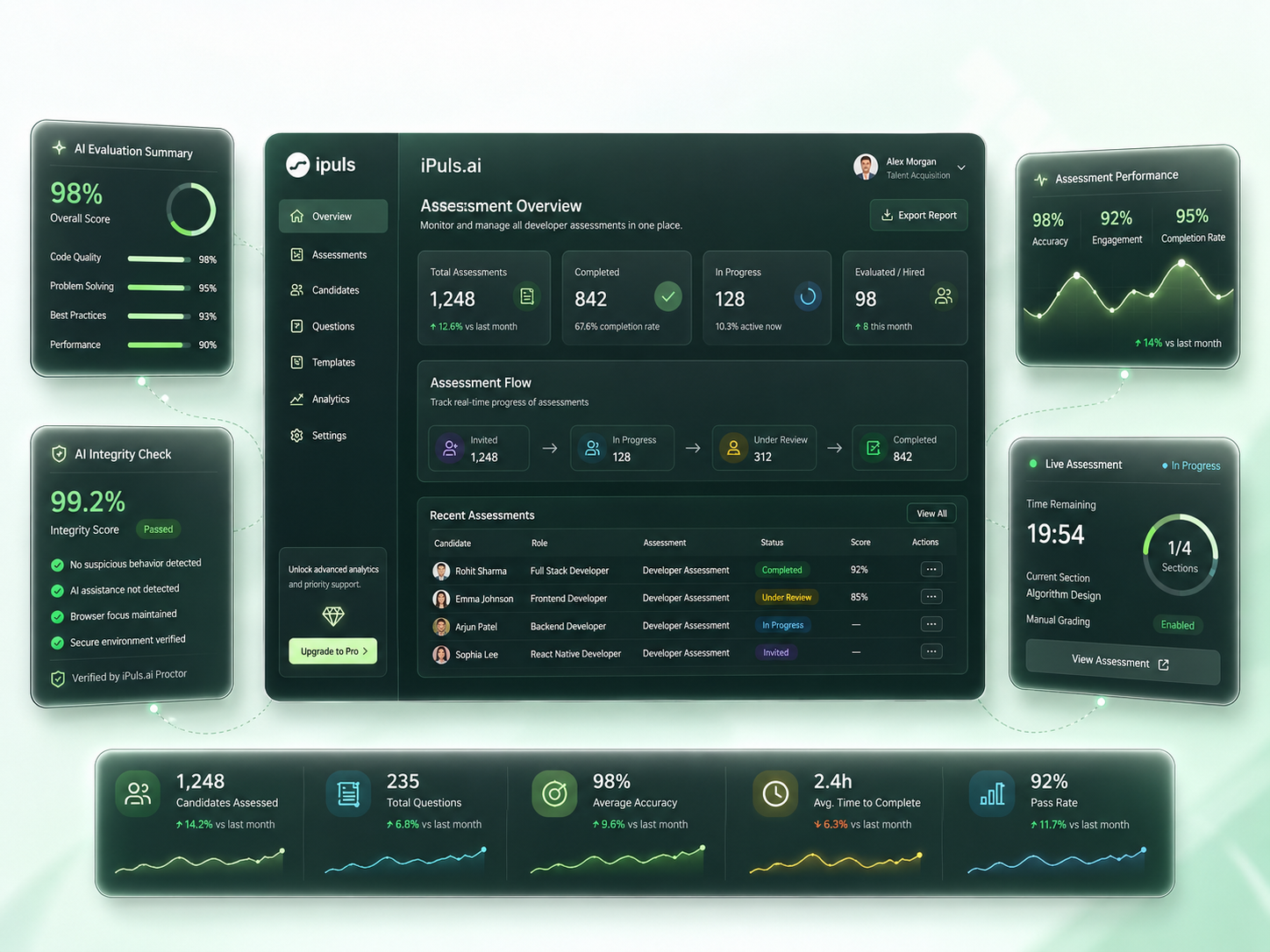
In technical recruiting, there is a recurring gap between how candidates perform on conventional assessments and how they execute tasks during their first month on the job. The reason is simple: most assessments evaluate a candidate's confidence under exam-like constraints rather than their actual capability to solve real-world problems.
The Limits of Resume Confidence and Rote Memorization
Standard multiple-choice tests and isolated algorithmic challenges (like balancing a binary tree) measure a very specific subset of human intelligence: the ability to recall memorized syntax and execute predefined patterns under tight time constraints. While these tests are easy to grade at scale, they offer a low-signal indicator of real job performance.
Relying on "resume confidence" or certifications often leads to false positives—candidates who talk a great game but struggle when faced with a complex codebase. True technical competence is not about knowing every function name by heart; it is about how you approach ambiguity, read existing code, debug edge cases, and design robust architectures.
"High-signal hiring requires moving away from checkbox checklists and toward immersive environments that simulate the actual operational reality of the role."
Three Core Pillars of Scenario-Based Assessment Design
To design assessments that predict day-one execution, hiring teams should focus on three critical dimensions:
- Scenario Depth: Instead of small, isolated code snippets, present candidates with a realistic project context. Give them a multi-file repository with existing code, a backlog of tasks, and realistic constraints.
- Role Contextualization: A backend engineer should be evaluated on database query optimization and API security, not frontend styling. A DevOps candidate should be tested on infrastructure configurations, container orchestration, and troubleshooting system bottlenecks.
- Evidence Layering: Combine code output metrics with qualitative signals—such as git commit logs, code quality, test coverage, and design choices. These layers provide a complete view of a developer's workflow.
Balancing Rigor with Candidate Experience
A common concern is that deep, scenario-based assessments might lead to candidate drop-off due to length. However, data shows that high-performing candidates appreciate realistic assessments because they resemble actual work. When candidates are given interesting, relevant challenges, they are more engaged and have a higher opinion of the company's technical standards.
By blending scenario depth with automated evaluation and fair time allocations, organizations can identify top talent while providing an engaging, high-end hiring experience.