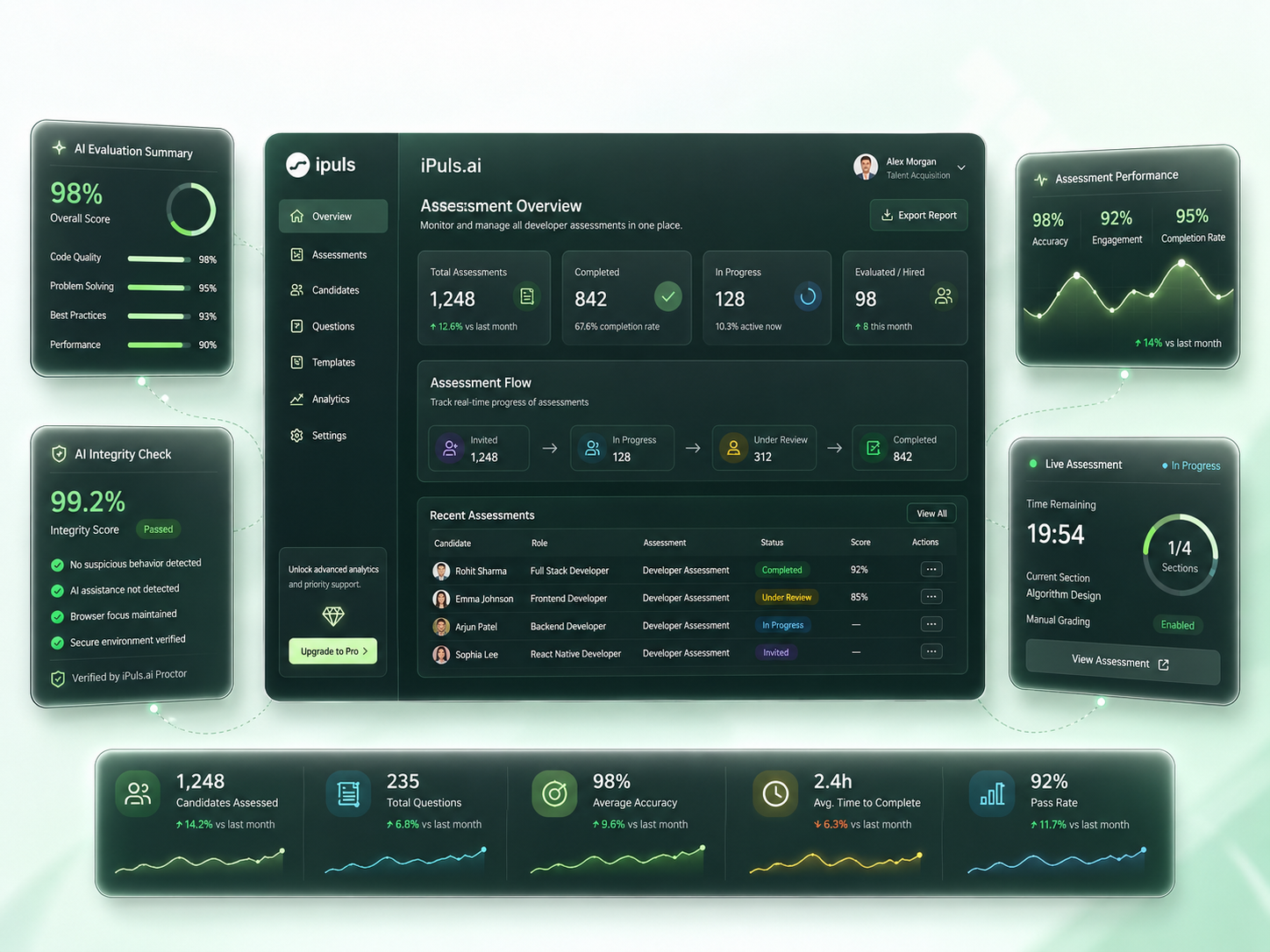

With the rise of generative AI, online technical assessments face a major integrity challenge. However, response measures that rely on invasive surveillance and strict browser lockdowns create a hostile candidate experience and fail to stop determined cheaters.
The Failure of Blunt Proctoring and Browser Lockdowns
Blunt proctoring tools—such as mandatory camera recording, eye tracking, and complete browser lockdowns—often generate high rates of false positives, trigger anxiety in candidates, and lead to high drop-off rates among top-tier candidates who refuse to install invasive software on their machines.
Furthermore, these tools are easily bypassed by secondary devices, and they do not measure the candidate's actual workflow. A smart approach relies on evidence layering and behavioral signal tracking, not surveillance.
"Assessment integrity should not feel like an interrogation. It should rely on telemetry patterns and scenario design that make copying impossible."
What Evidence Layering Looks Like
Evidence layering focuses on analyzing how a candidate arrives at their solution, rather than just checking their final output. This involves tracking session telemetry to build an objective trust profile:
- Keystroke Telemetry: Analyzing typing patterns and copy-paste events. Sudden injections of large blocks of code are flagged for review.
- Code Playback: Recording the exact sequence of code additions and modifications, allowing review panels to watch how the solution was constructed.
- Unique Scenarios: Designing custom, role-specific scenarios that cannot be solved by simply querying a public LLM.
Designing for Trust and Respect
By moving from surveillance to telemetry-driven evidence layering, companies can maintain the highest standards of integrity while respecting candidates' privacy and delivering a clean, modern hiring experience.