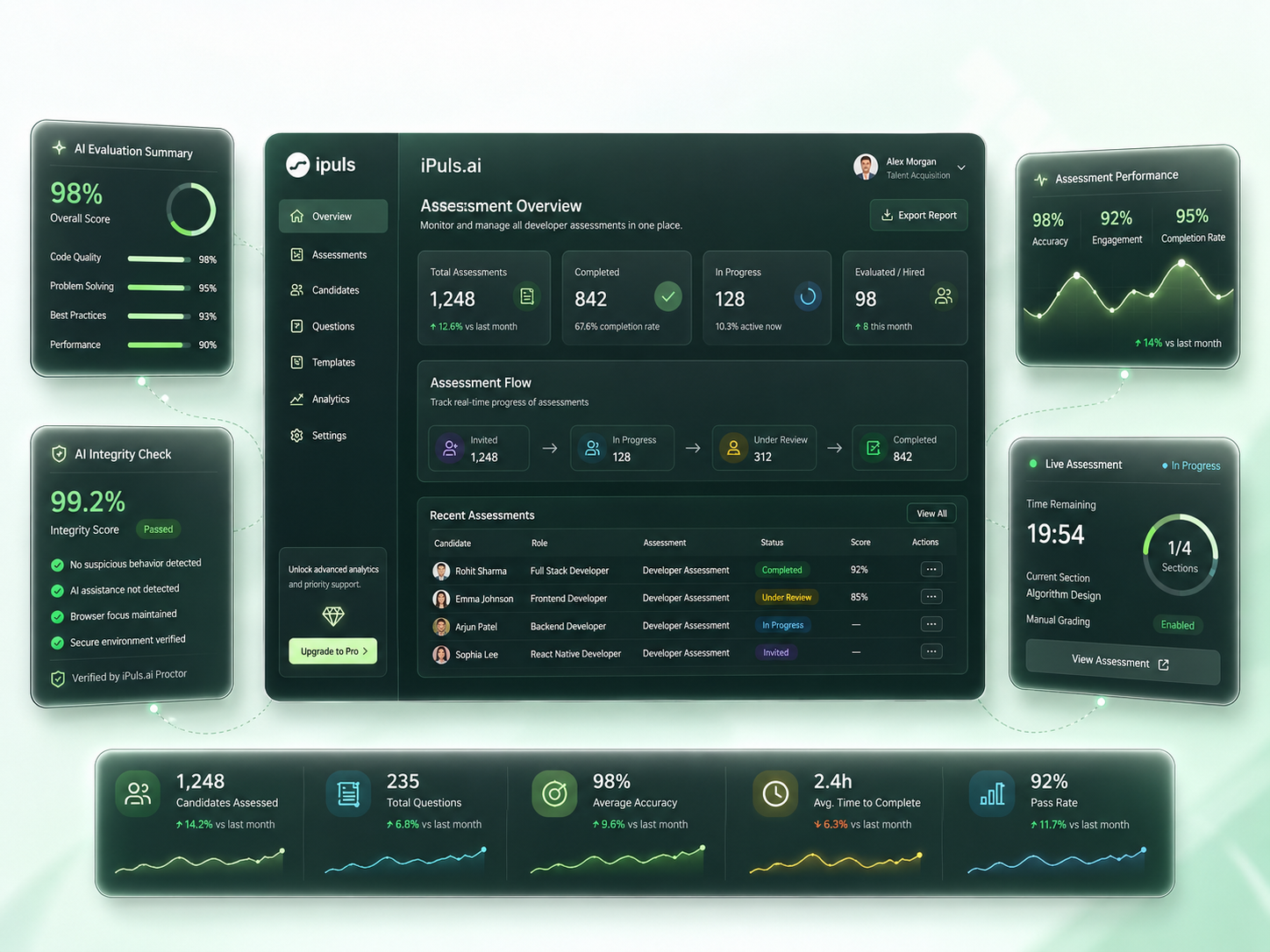

Many recruitment teams evaluate their pipeline health based solely on speed metrics: time-to-hire, source-to-hire ratio, and candidate volume. However, these metrics ignore the quality of the evaluation itself, leading to leaky pipelines and inconsistent hiring bars.
Operational Metrics That Matter
After each assessment cohort, hiring teams should evaluate telemetry and scoring distributions to calibrate their pipelines. Tracking these indicators helps ensure fairness, difficulty balance, and downstream success.
Key Cohort Telemetry to Analyze
- Score Distribution: If 90% of candidates score above 90, the assessment is too easy. If 80% score below 40, it is too hard. A healthy assessment has a bell-curve distribution.
- Drop-off Points: Identify exactly where candidates exit the session. High drop-off at a specific question suggests confusing instructions or unrealistic difficulty.
- Integrity Telemetry: Track the percentage of sessions flagged for copy-paste events or anomalous code updates to calibrate cheat filters.
Connecting Assessment Signals to Employee Performance
The ultimate validation of any hiring process is the quality of hire. By checking how candidates' assessment signals correlate with their actual job performance after six months, organizations can continuously optimize their test rubrics and selection criteria.